
Few things cause as much tension between neighbours as garden disputes. Overhanging branches dropping leaves into a pristine garden, overgrown boundary hedges encroaching on a driveway, roots lifting paving or damaging fencing, and disagreements over who is actually responsible for maintaining what – these situations come up regularly and can escalate quickly and destructively when handled badly or with entrenched positions.
At All Seasons Garden Maintenance, we work across gardens throughout Epsom, Ewell, Ashtead, Cheam, and the wider Surrey area. We have seen our share of these situations and understand how stressful they can become for everyone involved.
In this guide, we walk through your legal rights clearly, the practical etiquette that keeps neighbour relationships intact, and how regular professional garden maintenance is often the most effective long-term preventative measure of all.
Overhanging Trees: What Are Your Legal Rights?
The legal position in England and Wales
Under established UK law, you have the legal right to cut back any branches or roots from a neighbour’s tree or hedge that cross over the boundary line into your property – up to that boundary line and no further. Importantly, you do not need to ask permission from your neighbour to exercise this right.
However, there are critical caveats that must be observed:
- Any cuttings – branches, leaves, berries, and fruit – legally remain the property of your neighbour and should formally be offered back to them before disposal
- If the tree carries a Tree Preservation Order (TPO), cutting any part of it – even on your side of the boundary – may require prior consent from your local planning authority
- If the tree sits within a designated Conservation Area, similar legal restrictions can apply even without a specific TPO
- You must not cut branches or roots in a manner that would cause the tree to become structurally unsafe or to die – doing so could expose you to a civil claim from your neighbour
The practical, relationship-preserving approach
Even when you are entirely legally entitled to cut overhanging branches, it is almost always worth speaking to your neighbour first and letting them know your intentions.
A calm, friendly conversation prevents misunderstanding, demonstrates good faith, and preserves a neighbourly relationship that you will both benefit from long-term. In most cases, neighbours are genuinely happy to agree on a sensible, mutually acceptable approach – particularly when the person raising the issue is reasonable and specific about what they need.
Boundary Hedges: Who Is Responsible?
The legal position on hedge ownership
Legal responsibility for a boundary hedge depends entirely on ownership, which should be clearly recorded in the title deeds of the properties involved. The boundary is typically indicated by a ‘T mark’ on the official title plan held at the Land Registry – the property whose plan shows the T mark sitting on their side of the boundary is generally responsible for maintaining that boundary feature.
If you are unsure, your title deeds or a Land Registry search will clarify the position.
In practice, many boundary hedges are what are known as ‘party hedges’ – jointly owned by both neighbouring parties, typically because the hedge has grown on or close to the actual boundary line.
In these situations, both neighbours are equally responsible for the hedge’s maintenance and general condition, and both parties need to reach agreement before any significant changes – such as removal or substantial reduction in height – can be made.
High hedges and the role of local authorities
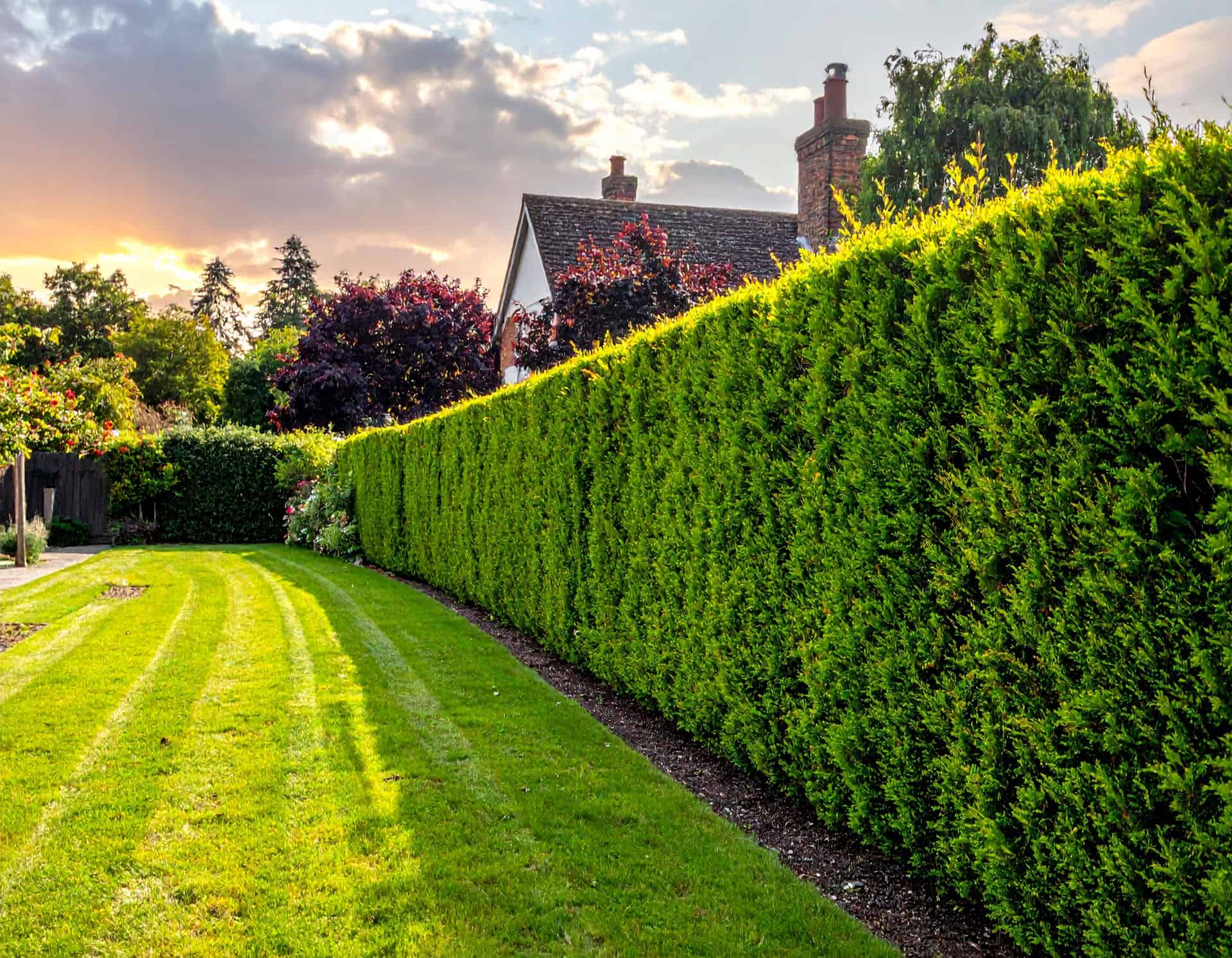
If a neighbour’s hedge is excessively tall and is genuinely blocking significant light to your home or garden, you may have recourse through your local authority.
Under Part 8 of the Anti-social Behaviour Act 2003, local councils have specific powers to require hedge owners to reduce the height of evergreen or semi-evergreen hedges where they are causing an unreasonable impact on a neighbouring property.
Making a formal complaint involves submitting evidence, paying an administrative fee, and demonstrating that you have already made genuine efforts to resolve the issue directly. It is a last resort process, but it does provide a formal route when direct conversation has genuinely failed.
Roots Causing Damage
Tree and hedge roots causing damage to driveways, paving, drainage pipes, or structures is another common source of neighbour disputes. The legal position here is more complex. If a neighbour’s tree roots are demonstrably causing physical damage to your property, you may have a case in nuisance law – but proving causation and pursuing a claim is rarely straightforward or inexpensive. Practical resolution through direct discussion, or through formal mediation services, is almost always a better first step than legal action.
Practical Tips for Staying on the Right Side of Your Neighbours
- Communicate early and proactively – if your hedge is approaching a size that could cause issues, let your neighbour know your trimming plans before rather than after
- Keep boundary hedges and trees well-maintained and neatly presented on both sides of the boundary – this is a basic demonstration of respect
- Never allow growth to become seriously out of control – a hedge trimmed regularly is far less likely to ever cause a dispute than one that has been neglected for years
- If you are uncertain about where the boundary actually falls, verify with your Land Registry title plan before any cutting or planting near the boundary line
- Consider a simple written or informal agreement with your neighbour about shared hedge maintenance – this avoids ambiguity and sets clear, agreed expectations
How Professional Maintenance Prevents Disputes
The single most effective preventative measure against boundary disputes is straightforward: keep your hedges and trees consistently well-maintained and within reasonable bounds.
A hedge that is professionally trimmed on a scheduled basis stays within its allocated space, looks well-presented from both sides, and gives your neighbour nothing reasonable to raise a concern about.
Our team at All Seasons Garden Maintenance carries out regular hedge trimming across Epsom and Surrey as a core element of our monthly maintenance packages. We work carefully and precisely around boundaries, always mindful of neighbouring properties and ensuring that all sites are left clean, tidy, and free from debris.
If you need a one-off hedge or tree tidying service to restore things to a good baseline before starting a regular maintenance programme, we can arrange that too.
Get in touch to arrange professional hedge maintenance: 01372 610566